After Ozempic or Mounjaro: What Happens to Your Body After Major Weight Loss?


Understanding loose skin, breast changes, stubborn fat, and your plastic surgery options after GLP-1 or significant weight loss
Over the past few years, I have seen a new type of patient increasingly coming into my consultation room.
She has lost the weight.
Sometimes 30 or 40 pounds. Sometimes 75 or 100 pounds or more.
She may have used a GLP-1 medication such as Ozempic, Wegovy, or Mounjaro. She may have undergone weight-loss surgery. Or she may have lost weight through changes in nutrition and exercise.
She feels healthier. Her clothes are smaller. Her energy may be better. And she is understandably proud of what she has accomplished.
But then she tells me something like:
“I lost all this weight, but I still don't feel comfortable with my body.”
Often, the problem isn't the weight anymore.
It's what the weight loss left behind.
Significant weight loss can change the body in ways that diet, exercise, and even continued weight loss cannot correct. Skin that has been stretched for years doesn't always shrink to fit a smaller body. Breasts may lose volume. The abdomen may develop folds of excess skin. Areas that once looked full can suddenly look deflated.
And sometimes patients are surprised by this.
So what actually happens to your body after major weight loss—and what can plastic surgery realistically do about it?
Why Doesn't the Skin Just Shrink?
Skin has an impressive ability to stretch and contract, but it has limits.
When the body carries additional weight, the skin gradually expands to accommodate it. After significant weight loss, particularly when it occurs relatively quickly, the skin may not have enough elasticity to fully contract around your new shape.
How much loose skin remains depends on many factors, including:
How much weight you lost
How long you carried the additional weight
Your age
Genetics
Skin quality
Pregnancy history
Smoking history
Where your body previously stored fat
This is why two people who lose the same number of pounds can look very different afterward.
It is also important to understand that loose skin isn't something you can exercise away.
Exercise can strengthen the muscles underneath it. It cannot remove skin that has lost its elasticity.
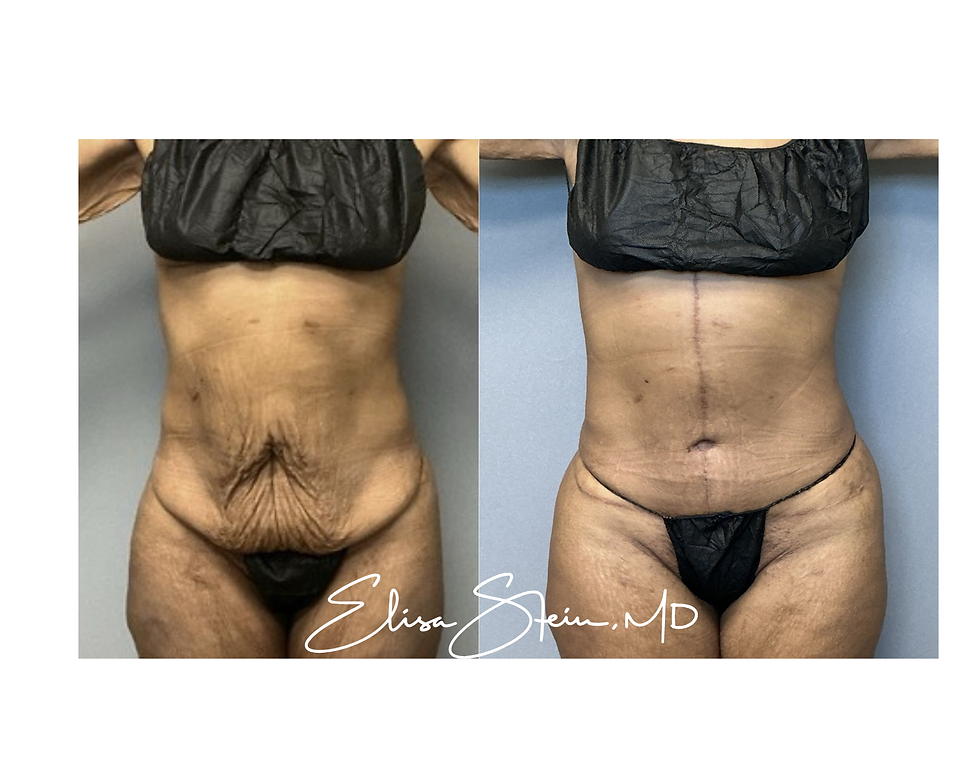
The Abdomen: Loose Skin After Weight Loss
The abdomen is one of the most common areas patients want to address after major weight loss.
Some patients are left with loose skin primarily below the belly button.
Others develop an apron of skin that hangs over the lower abdomen.
And patients who have lost very large amounts of weight may have excess skin extending across the abdomen and around the sides of the body.
This is why there isn't one “tummy tuck” that works for everyone.
Depending on your anatomy, your options might include a mini tummy tuck, full abdominoplasty, extended tummy tuck, or Fleur-de-Lis abdominoplasty.
A Fleur-de-Lis tummy tuck can be particularly useful after massive weight loss because it removes excess skin in both the vertical and horizontal directions.
I've written an entire guide explaining these differences: “Which Tummy Tuck Is Right for You?”
The important point is that the operation should be selected based on where your excess skin is located, not simply on how much weight you lost.
What Happens to the Breasts After Major Weight Loss?
The breasts can change dramatically with weight loss.
Breasts contain both glandular tissue and fat. As body fat decreases, some women lose significant breast volume.
But the skin that previously surrounded that volume doesn't necessarily contract with it.
The result can be breasts that appear:
Deflated
Flattened
Empty in the upper portion
Lower on the chest
More asymmetrical
Larger in their skin envelope than the amount of breast tissue remaining
One of the most important decisions is determining whether you need volume, a lift, or both.
A breast lift removes excess skin and reshapes the existing breast tissue, but it does not necessarily restore the volume that was lost.
For some women, a breast lift alone provides exactly the result they want.
Others may benefit from adding an implant or, in selected patients, fat grafting to restore fullness.
I explain this distinction in more detail in “What a Breast Lift Can (and Can't) Do for You.”
The goal isn't to recreate the body you had before weight loss.
It's to create proportions that make sense for the body you have now.
Loose Skin or Stubborn Fat? They're Not the Same Thing
This is another common source of confusion.
A patient may come into my office, pinch the lower abdomen and tell me:
“I just need this fat removed.”
Sometimes that's true.
But sometimes what she's holding is mostly skin.
Liposuction removes fat.
It does not remove significant excess skin.
In fact, removing fat from an area with poor skin elasticity can sometimes make loose skin more noticeable.
That's why deciding between liposuction and a tummy tuck requires examining three separate things:
Fat. Skin. Muscle.
If you have good skin elasticity and a localized pocket of stubborn fat, liposuction may be appropriate.
If the primary problem is loose skin, removing more fat isn't going to solve it.
And if pregnancy has also left you with separation of the abdominal muscles, a tummy tuck may be needed to address the abdominal wall as well.
I'll explore this distinction more fully in an upcoming article on tummy tuck vs. liposuction.
Weight Loss Can Affect More Than Your Abdomen and Breasts
Major weight loss can leave loose skin throughout the body.
Patients may notice changes in the:
Upper arms
Inner and outer thighs
Buttocks
Back and bra-line area
Neck and face
Trying to correct everything at once is not always the safest—or best—approach.
For patients with multiple areas of concern, body contouring may need to be performed in stages.
One of the most important parts of the consultation is deciding what bothers you most and developing a surgical plan that prioritizes those areas safely.

When Are You Ready for Plastic Surgery After Weight Loss?
Reaching your goal weight doesn't necessarily mean you're immediately ready for surgery.
In general, I want patients to be at or near their goal weight and maintaining a stable weight before we begin body-contouring surgery.
Why?
Because continued significant weight loss after surgery can create additional loose skin and change the result we worked to achieve.
Similarly, substantial weight gain can stretch tissues again.
Plastic surgery is not a weight-loss treatment. Ideally, it is the step that comes after the weight-loss phase, when your body has reached a place you can realistically maintain.
Your overall health matters as well.
Nutrition Matters More Than You May Realize
This is especially important after substantial weight loss.
Your body needs adequate nutrition to heal surgical incisions, build collagen, fight infection, and recover from surgery.
Someone can reach a healthy—or even low—body weight and still have nutritional deficiencies.
This can be particularly important after bariatric surgery, but rapid or significant weight loss through other methods can also affect nutritional intake.
Before major body-contouring surgery, your surgeon may evaluate your overall health and nutritional status and may recommend laboratory testing or coordination with your primary-care physician or other members of your medical team.
The number on the scale is only one part of determining whether your body is ready for surgery.
What If You're Still Taking a GLP-1 Medication?
Tell your surgeon.
Medications such as Ozempic, Wegovy, and Mounjaro are part of your medical history just like any other prescription medication.
GLP-1 medications can affect digestion and gastric emptying, which can be relevant to anesthesia and surgical planning. Recommendations about how these medications should be managed around surgery continue to evolve and should be individualized.
Don't stop your medication on your own.
Your surgeon and anesthesia team should know exactly what you're taking, the dose, why you're taking it, and when you last took it so they can give you appropriate instructions for your procedure.
Preparing for Body-Contouring Surgery
Body-contouring surgery after significant weight loss can be transformative, but these are real operations that require thoughtful preparation.
Before surgery, I encourage patients to think beyond the operation itself.
Who will help you at home?
How much time will you need away from work?
Who will help with children or pets?
Are you eating enough protein and maintaining good nutrition?
Have you stopped nicotine use?
Have you filled your prescriptions and prepared your recovery area?
Preparation can make the early postoperative period much less stressful.
I've created a more detailed guide here:
Surgery Isn't the Beginning of Your Weight-Loss Story
I think this is perhaps the most important point.
When a patient comes to me after losing 50, 75, or 100 pounds, plastic surgery isn't responsible for her transformation.
She already did that.
The medication may have been a tool. Bariatric surgery may have been a tool. Changes in nutrition and exercise may have been tools.
But the commitment to improving her health was hers.
Plastic surgery simply addresses some of the things weight loss cannot.
It can remove skin that no longer contracts.
It can reshape breasts that have lost volume.
It can improve body contours that don't reflect the amount of work someone has already put into changing her health.
That's a very different goal from using plastic surgery to lose weight.
What Does Your Body Need After Weight Loss?
There is no standard “post-Ozempic makeover.”
And I don't think there should be.
One woman may only be bothered by her abdomen.
Another may want a breast lift.
Someone else may have loose skin involving her abdomen, breasts, arms, and thighs and benefit from a staged approach over time.
The right plan depends on your anatomy, your health, your priorities, and what will safely give you the most meaningful improvement.
Ready to Talk About What's Next?
If you've achieved significant weight loss with Ozempic, Wegovy, Mounjaro, bariatric surgery, or lifestyle changes and are wondering what can be done about the changes left behind, I invite you to schedule a consultation.
We'll talk about where you are in your weight-loss journey, evaluate the areas that concern you, and discuss which changes may improve without surgery—and which ones likely won't.
Most importantly, we'll create a plan based on your body and your goals, rather than trying to fit you into a predefined “makeover.”
Losing the weight may have been one chapter of your story.
Now you get to decide what comes next.


Comments